
 how-to
How to Identify High Quality Fashion Jewelry Online
Table of Contents
- Understanding What Makes Fashion Jewelry High Quality
- Gold Plated vs Gold Vermeil vs Gold Filled: Which Lasts Longer
- Check Metal Hallmarks and Jewelry Hallmark Meanings
- How to Spot Fake Jewelry Online Before You Buy
- Evaluate Craftsmanship and Prongs Before Purchasing
- Verify Seller Reputation and Return Policies
- What to Do After Your Jewelry Arrives
- Conclusion
Last Updated: August 13, 2026
Understanding What Makes Fashion Jewelry High Quality
High quality fashion jewelry combines durability, aesthetic appeal, and honest materials that won't tarnish or turn your skin green within weeks. The difference between pieces that last and those that disappoint comes down to three factors: the base metal composition, the craftsmanship of the setting, and the thickness of any plating or coating applied.
When shopping online, you can't hold the piece or test it in person. Identifying high quality fashion jewelry requires evaluating product photos, reading descriptions carefully, and understanding what sellers are actually telling you. You don't need expertise to spot quality, you need to know what to look for. This guide walks you through the exact steps CSShop customers use to avoid low-quality pieces and find jewelry that holds up to daily wear.

Gold Plated vs Gold Vermeil vs Gold Filled: Which Lasts Longer
These three terms describe different methods of coating base metal with precious metal and are not interchangeable.
Gold plated means a thin layer of gold (typically 0.5 microns or less) is electroplated onto brass or copper. This is the thinnest option, lasting 6 months to 2 years with regular wear.
Gold vermeil is gold plating applied to sterling silver. The base must be sterling silver (92.5% pure), and the gold layer is at least 2.5 microns thick. Because the base metal is more precious than brass, vermeil pieces resist tarnishing better and last 3-5 years with normal wear.
Gold filled involves a layer of gold mechanically bonded to a base metal core (not electroplated). The gold layer must be at least 1/20th of the total weight of the piece. This is substantially thicker and more durable than plating, lasting 10+ years or even a lifetime if cared for properly.
For online shopping, look for these terms explicitly in the product description. If a listing just says "gold" without specifying plated, vermeil, or filled, ask the seller before buying.
Check Metal Hallmarks and Jewelry Hallmark Meanings
Hallmarks are tiny stamped marks on metal that indicate purity and manufacturing details. They're your proof of what you're actually buying.
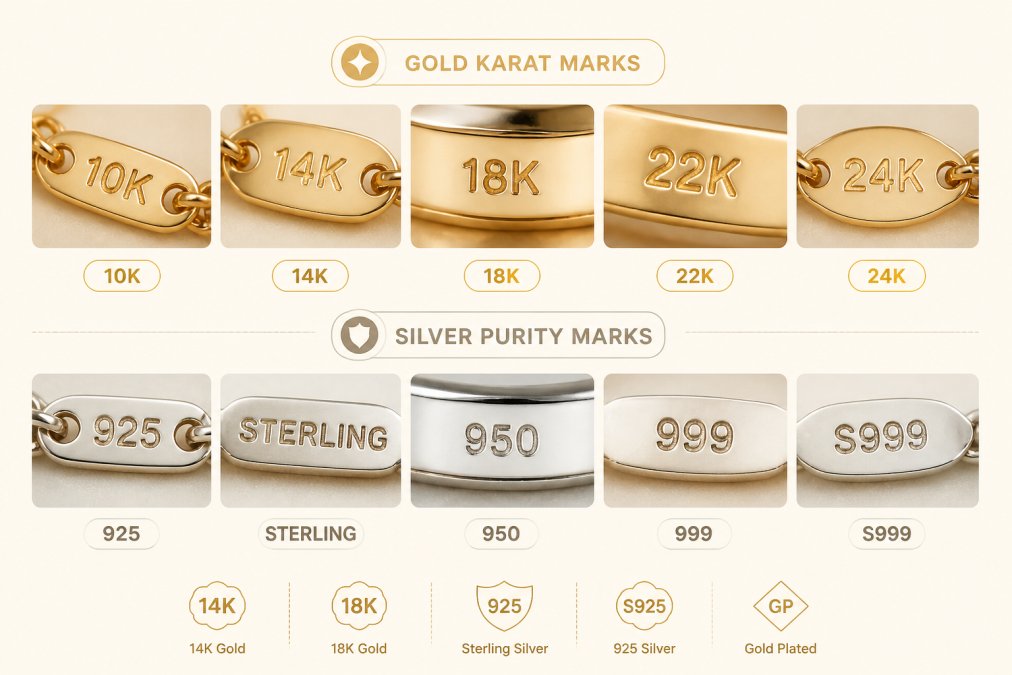
On gold jewelry, you'll see marks like:
- 10K, 14K, 18K, 24K, indicates karat weight and gold purity
- 585, 750, 916, numeric codes representing the same purity (585 = 14K, 750 = 18K)
- GP, GEP, or PLATED, indicates gold plating rather than solid gold
- VRM or VERMEIL, indicates gold vermeil
On silver jewelry:
- 925 or STERLING, indicates sterling silver (92.5% pure)
- 950, indicates higher purity silver
- SILVER PLATE or SP, indicates plated silver, not solid
On costume or fashion jewelry:
- NICKEL FREE, indicates the piece won't trigger allergic reactions
- HYPOALLERGENIC, means the alloy composition is designed to minimize reactions
When shopping online, hallmarks should appear in product photos. If you can't see them clearly, ask the seller for a close-up photo. Legitimate retailers have nothing to hide.
How to Spot Fake Jewelry Online Before You Buy
Spotting low-quality or counterfeit jewelry requires analyzing product photos and verifying seller legitimacy through digital due diligence.
Macro-Photography Analysis: What to Look for in Product Images
High-quality sellers invest in detailed photography because the image is your only tactile connection to the piece.
Solder marks and joint quality: Quality solder work appears smooth and flush with surrounding metal. Poor quality shows visible lumps, gaps along seams, discoloration around joints, or rough texture. If a listing has no close-up photos of joints, ask the seller to provide them.
Plating thickness and evenness: Gold-plated and gold-filled pieces should show consistent color across the entire surface. Watch for color variation, visible base metal showing through, dull patches, or wear patterns that shouldn't exist on new jewelry.
Prong and stone setting security: Quality prongs should sit evenly spaced around the stone with no visible gaps, have smooth finished edges, hold the stone flush against the base, and show no cracks or deformation. If a stone appears loose or at an angle, the piece will likely shed the stone within weeks.
Clasp and closure mechanisms: Quality clasps show smooth, even surfaces with no rough spots, secure-looking closure points, consistent finish matching the rest of the piece, and no visible gaps or loose components.
Digital Due Diligence: Verifying Seller Legitimacy
Reverse image search: Copy the product photo URL and run it through Google Images or TinEye. This reveals whether the same image appears on multiple unrelated websites (a sign of dropshipping), whether the image is stolen from a brand's official site, or how long the image has been circulating online. Legitimate retailers typically use original photography.
Social media verification: Check the seller's social media presence for consistent posting history, customer photos and tags, behind-the-scenes content, and consistent branding. If a seller claims to be a jewelry brand but has no social media presence or only a handful of followers with no customer photos, investigate further.
Website and domain analysis: Examine the seller's website for a professional domain name relevant to jewelry, an "About Us" page with real company information, multiple contact methods, a physical address, and HTTPS encryption (look for the padlock icon). Legitimate retailers provide these; dropshippers often don't.
Review authenticity: Read customer reviews carefully for specific details about materials and durability, photos from verified buyers, a mix of ratings (not only 5-star reviews), and varied review dates. Generic praise or reviews all from the same week suggest purchased reviews.
Red Flags in Product Descriptions
Vague material claims:
- "Gold-tone," "antique gold," or "gold-look" = not gold
- "Gemstone" without specification = likely glass or crystal, not real gemstones
- "Hypoallergenic" without material specification = may still contain nickel
- "Vintage-inspired" or "vintage-style" = new piece made to look old
Missing information:
- No mention of hallmarks or purity stamps
- No weight listed
- No care instructions
- No return policy mentioned
Price inconsistencies: Compare the asking price to similar pieces from established retailers. A gold vermeil bracelet listed at 70% below market rate warrants investigation. Legitimate reasons for lower prices include seasonal sales, direct-to-consumer models, or bulk discounts.
Evaluate Craftsmanship and Prongs Before Purchasing
Craftsmanship shows in the details: how prongs hold stones, how solder joints are finished, and whether the piece feels substantial.
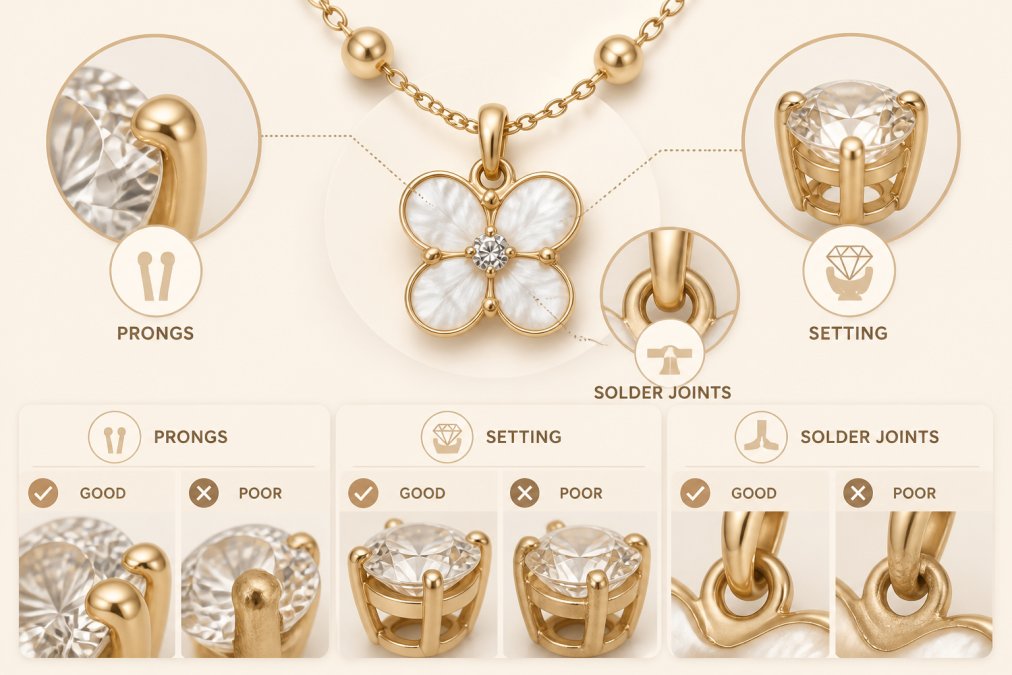
When reviewing online photos, look for evenly spaced and smoothly finished prongs, smooth and flush solder joints, secure and well-constructed clasps, and consistent finish across the entire piece. For pieces with gemstones, verify that the stone is secure and won't move or rattle when handled.
Verify Seller Reputation and Return Policies
Your best protection when buying fashion jewelry online is choosing a seller with a proven track record and fair return policy.
Before purchasing, check recent customer reviews for patterns, verify the seller offers at least 14-30 days to return items, send a message asking about materials to gauge response time, and look for certifications or memberships on the seller's profile.
CSShop is a curated retailer focused on quality and customer satisfaction. Our jewelry collections are selected for durability and style, and we stand behind every piece with straightforward return policies and responsive customer service.
What to Do After Your Jewelry Arrives
Your evaluation doesn't end when the piece arrives. The first few days are critical for spotting problems before the return window closes.
Immediate Visual and Physical Inspection
Compare to product photos: Check the piece against the product photos for color, size, and finish consistency. Look for hallmarks under good lighting using your phone's camera or magnifying glass. Inspect for damage in transit: bent prongs, cracked stones, dented metal, or loose components. Test clasps, prongs, and closures for security. For gemstones, confirm they're secure and don't move or rattle.
Check finish quality: Run your finger along seams and joints, they should feel smooth, not rough or lumpy. Look for solder marks, rough edges, or unfinished areas. Verify the polish or texture is consistent across the entire piece.
At-Home Material Verification Tests
The magnet test (for stainless steel and base metals): Hold a strong magnet near the jewelry. If the piece is attracted to the magnet, it contains iron or steel. Stainless steel jewelry is magnetic. Sterling silver, gold, and copper are not. If a piece claims to be gold or silver but is strongly magnetic, the material claim is false.
The weight test (for gold and silver): Research the typical weight of similar pieces online and use a digital scale to weigh the piece. Compare to the seller's stated weight if provided. Gold is denser than silver: a solid gold ring will feel noticeably heavier than a sterling silver ring of the same size.
The skin reactivity test (for nickel and allergenic metals): Wear the piece for 2-4 hours in a clean area of skin. Quality fashion jewelry should be nickel-free or have a protective barrier. If your skin turns green, develops a rash, or itches, the piece likely contains nickel or other reactive metals. Document any reaction with photos for return purposes.
The tarnish test (for silver and plated pieces): Wear the piece normally for 3-5 days and observe for tarnishing or plating wear. Sterling silver naturally tarnishes slowly (weeks to months with normal wear). If a piece claiming to be sterling silver or gold vermeil shows significant tarnishing within a week, it's lower quality than represented. Gold-filled pieces should show no wear or fading after a week of wear.
The acid test (for gold purity, advanced): Gold testing kits use chemical reactions to verify gold purity. This test is definitive but requires careful handling. For most buyers, the magnet and weight tests are sufficient. Reserve the acid test for high-value purchases.
Documentation and Return Process
Keep records: Take photos of the piece as received, including close-ups of hallmarks and any damage. Keep the original packaging and any documentation. Note the date you received the piece and the date you performed any tests.
Contact the seller immediately if issues arise: If the piece doesn't match the product description, shows unexpected wear, fails a material test, or causes an allergic reaction, contact the seller within the return window. Provide clear photos and explain the specific issue. Most legitimate retailers will accept returns if the piece doesn't meet advertised standards. If the seller refuses, escalate through your payment platform.
Conclusion
Identifying high quality fashion jewelry online comes down to reading three signals: what the seller shows you (photos and descriptions), what the piece tells you (hallmarks and craftsmanship), and what other customers report (reviews and return policies). Start by looking for clear hallmarks, detailed product photos, and honest material descriptions. Compare prices to similar pieces, check seller reviews and return policies, and always inspect your purchase immediately after it arrives.
Ready to find high quality fashion jewelry that matches your style? Explore CSShop's curated collections of fashion jewelry and bridal accessories. Every piece is selected for quality and durability, backed by our straightforward return policy and fast delivery. Visit csshop.shop to browse our latest selections.
Discover beautiful, curated pieces with our Jewelry Mystery Boxes. Perfect for building your jewelry collection or gifting to someone special, these mystery boxes offer an exciting way to explore quality pieces while enjoying the thrill of discovery.

Frequently Asked Questions
How can you tell if fashion jewelry is high quality?
High quality fashion jewelry shows secure prongs, clean solder joints, and proper hallmarks. Check that gemstones sit firmly in their settings, metal surfaces are smooth without rough edges, and the clasp closes securely. Look for karat stamps on gold pieces and sterling silver marks on silver. Quality pieces have consistent finish without tarnish or discoloration in product photos. Read seller reviews mentioning durability and how long pieces last before tarnishing.
What's the difference between gold plated, gold vermeil, and gold filled?
Gold plated has the thinnest coating, often wearing off within weeks. Gold vermeil requires at least 2.5 microns of plating over sterling silver, lasting longer and resisting tarnish better. Gold filled has 5-10% gold by weight bonded to base metal, offering the most durability and lasting years with proper care. For jewelry you'll wear frequently, gold vermeil or gold filled are better investments than gold plated pieces.
How do I know if jewelry hallmarks are real?
Real hallmarks are stamped clearly into metal, not printed or glued on. Common legitimate marks include karat stamps (10K, 14K, 18K for gold), 925 or 950 for sterling silver, and maker's marks. The hallmark should be consistent with the metal type, solid gold pieces have karat stamps, gold plated items may show GP or plating thickness. If a listing shows no hallmarks or unclear stamps, the seller may be hiding the metal composition.
What are the biggest red flags when shopping for jewelry online?
Avoid listings with blurry photos, inconsistent lighting, or images that don't show hallmarks or clasp details. Be suspicious of prices significantly lower than comparable pieces elsewhere, vague material descriptions like 'gold-tone' instead of specific karat or plating type, and sellers with no return policy or negative reviews mentioning tarnishing. Check that the seller clearly states plating thickness for gold plated pieces and provides certification for gemstones.
This article was written using GrandRanker