
 listicle
Affordable Alternatives to Luxury Fashion Staples
Table of Contents
- Why Affordable Luxury Staples Beat Designer Prices
- Quick Comparison: Affordable Alternatives Side by Side
- Materials That Decide Whether a Piece Lasts
- How to Style Crystal Jewelry for a High-End Look
- Identifying Authentic Natural Stones Before You Buy
- Jewelry Care Tips for Longevity
- Where to Find Affordable Luxury Staples
- Conclusion
- Frequently Asked Questions
Last Updated: October 2, 2026
Why Affordable Luxury Staples Beat Designer Prices
The gap between a designer price tag and the actual cost of materials is wider than most shoppers realize. Affordable alternatives to luxury fashion staples close that gap by focusing on three things: metal quality, stone authenticity, and construction that holds up to daily wear.

Quick Comparison: Affordable Alternatives Side by Side
Here is how the most common luxury staple categories compare when you swap designer pricing for thoughtful alternatives.
| Staple Category | What Luxury Charges For | Affordable Alternative | What to Check Before Buying |
|---|---|---|---|
| Fine necklaces | Brand name, solid gold | Sterling silver, titanium steel, plated platinum | Base metal, plating type |
| Statement rings | Diamond settings | CZ in pavé settings on S925 silver | Stone setting security |
| Stud earrings | Designer hallmark | Zircon inlays on alloy or steel | Post thickness, backing type |
| Crystal pendants | Certified provenance | Natural stone with visible inclusions | Color zoning, internal flaws |
| Layering chains | Solid gold links | Stainless steel clavicle chains | Clasp strength, chain gauge |
How to Read the Table
Start with the "What to Check" column. That is where value lives or dies. A titanium steel necklace with a secure clasp will outlast a poorly finished gold-plated piece at ten times the price. Look for the base metal first, then the plating, then the stone setting.

Materials That Decide Whether a Piece Lasts
Material choice is the single biggest predictor of whether a piece survives a year. Two necklaces can look identical on a product page and behave completely differently after three months of wear.
Sterling Silver, Titanium Steel, and Alloy Compared
Sterling silver is 92.5% pure silver mixed with copper for strength. It tarnishes over time but polishes back to full shine, which makes it a genuine long-term buy.
How to Style Crystal Jewelry for a High-End Look
Crystal jewelry reads expensive when the stone is treated as the focal point and everything around it stays quiet. The difference between a piece that looks bespoke and one that looks like costume jewelry usually comes down to four measurable choices: scale, metal tone, chain gauge, and how the stone sits against the skin.
Scale the stone to the frame
A pendant that is too small disappears; one that is too large overwhelms. Statement rings follow a similar rule: a stone wider than the finger's first knuckle tends to look costume rather than fine.
Match metal tone deliberately
Warm tones (yellow gold, rose gold, brass) flatter warmer skin undertones. Cool tones (platinum, white gold, sterling silver, titanium steel) flatter cooler undertones. Mixing the two can work, but it requires a deliberate anchor, usually one dominant metal repeated at least twice. Starting out, keep every visible metal on the body the same tone.
Choose chain gauge to control presence
Chain gauge is measured in millimeters of link thickness. Under 1 mm reads delicate and disappears under most necklines. Between 1 mm and 2 mm is the everyday range that still shows against skin. Above 3 mm becomes a statement on its own and competes with any pendant hanging from it.
Let the neckline frame the stone
When layering, keep the longest chain at least 2 inches below the shortest so the two do not tangle at the clasp, a 16-inch choker plus an 18-inch pendant is the most common pairing that works.
Keep the supporting pieces subordinate
One crystal statement plus one plain supporting piece is the reliable formula. A pavé crystal pendant over a single plain chain. A crystal ring on one hand, nothing competing on the other. When two crystals sit within the same visual zone, the eye cannot decide which is the focal point and both read as less expensive than either would alone.
Finish the details
A few small habits separate a polished look from a cluttered one:
- Keep the clasp rotated to the back of the neck, not the side.
- Match earring metal to necklace metal when both are visible.
- Keep stone color within one family, clear, champagne, or a single saturated tone, rather than mixing several.
- Let the crystal be the only sparkle; skip additional rhinestone or sequin accents nearby.
Identifying Authentic Natural Stones Before You Buy
Natural stones carry small imperfections. That is the simplest test you can run.
Look for:
- Color zoning. Real stones shift tone slightly across the surface. Uniform color often signals glass or synthetic material.
- Internal inclusions. Tiny bubbles, fractures, or mineral flecks are normal in natural stone. Perfect clarity at a low price is a warning sign.
- Weight and temperature. Natural stone feels cooler to the touch and denser than plastic or resin imitations.
- Consistent but not identical. If you buy two pieces from the same batch, natural stones will differ slightly. Identical twins suggest molded material.
Jewelry Care Tips for Longevity
Care is where most people lose the value they paid for. A few habits extend the life of any piece dramatically.
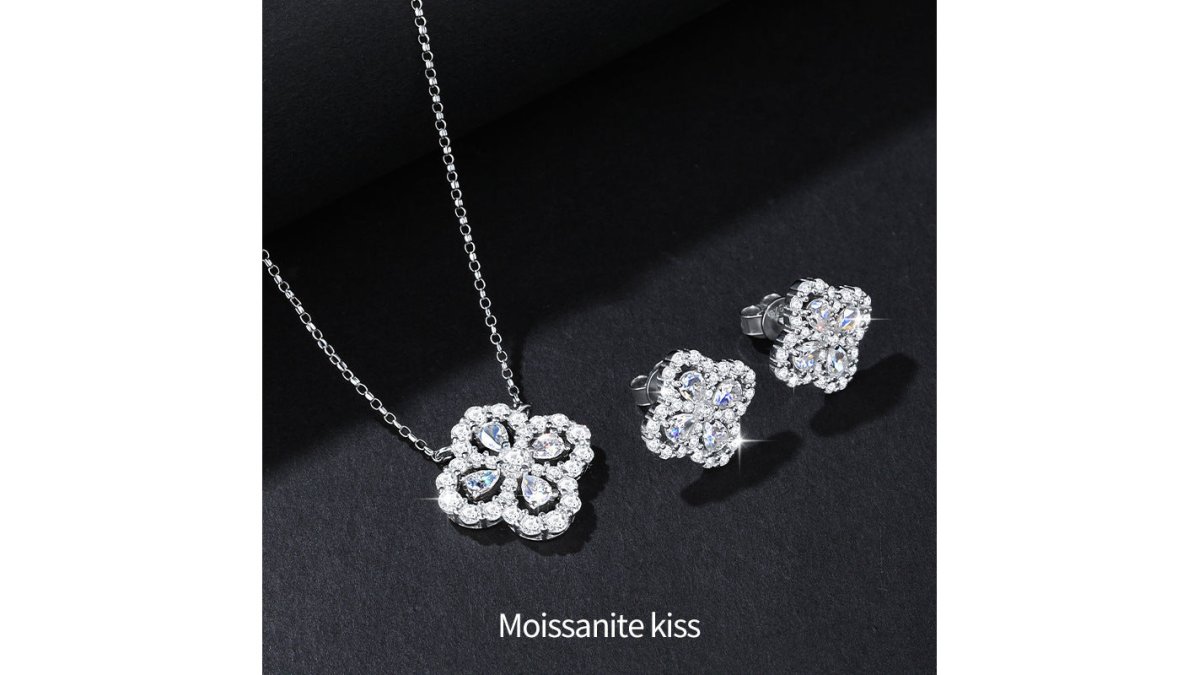
Women's Luxury High-grade Fashion Sterling Sier Four Leaf Necklaces →
- Put jewelry on last, after perfume, lotion, and hairspray have dried
- Remove rings and necklaces before swimming, showering, or cleaning
- Wipe each piece with a soft dry cloth after wearing
- Store pieces separately in a lined box or pouch to prevent scratching
- Keep silver in an airtight bag to slow tarnishing
- Polish silver with a treated cloth rather than abrasive cleaners
- Check clasps and stone settings every few months
Where to Find Affordable Luxury Staples
The best sources share one trait: they tell you exactly what the piece is made of, and they will answer a follow-up question. That second part matters more than most shoppers expect, because it separates a seller who knows their inventory from one who is reselling whatever arrived on a pallet.
Read the listing like a spec sheet
A useful listing names four things: base metal, plating type and thickness, stone type, and setting style. A listing that says "S925 sterling silver, platinum-plated, 2-micron plating, CZ pavé setting" gives you something to verify. A listing that says "gold-tone" or "premium alloy" gives you nothing, because those terms have no standardized meaning in the jewelry trade.
Red flags to watch for:
- "Gold-tone" or "gold-color", no metal content is stated.
- "Premium alloy", the base metal is unnamed.
- "Lab-created diamond" used interchangeably with "CZ", these are different materials and a seller who conflates them is either uninformed or misleading.
- No plating thickness stated on a plated piece, plating under roughly 1 micron wears through quickly on rings and bracelets.
- Stock photos only, with no image of the actual clasp, hallmark, or stone setting.
Ask three questions before buying
- What is the base metal? (Sterling silver, titanium steel, stainless steel, brass, or alloy?)
- If plated, what is the plating thickness in microns?
- Is the stone natural, lab-created, or synthetic?
A seller who answers all three clearly is a seller worth returning to. Evasiveness on any one of them is the signal, not the price.
Check for hallmarks and stamps
Sterling silver is stamped "925" or "S925." Platinum is stamped "PT" or "950." Titanium and stainless steel are usually not hallmarked, but a reputable seller will state the grade (for example, 316L stainless steel). A piece claiming sterling silver with no stamp is worth questioning.
Use the resale and estate market deliberately
Estate and resale pieces often carry better materials than new budget jewelry at similar prices, because older pieces were frequently made in solid sterling or solid gold rather than plated base metal. The trade-off is that you must inspect or ask detailed questions, since returns are often limited.
What to verify on a resale piece:
- Hallmarks and maker's marks. Photograph them and look them up before committing.
- Magnet test. Sterling silver and gold are not magnetic; a strong pull suggests a base-metal core.
- Weight in hand. Solid sterling and solid gold feel denser than plated or hollow pieces of the same size.
- Stone condition. Look for chips at the girdle, loose prongs, or cloudy stones, repairs often cost more than the piece.
- Clasp and hinge function. Open and close every clasp and hinge before buying; replacement clasps are common and cheap, but a broken hinge on a bangle is not.
Prefer curated boutiques for everyday staples
For pieces you will wear daily, a curated boutique beats a mass marketplace on three dimensions: fewer options (so the description quality is higher), named materials (so you can verify), and a return policy you can actually use. Mass marketplaces win on price and selection, but the listing quality is inconsistent and returns are often slow.
Match the source to the piece
- Daily-wear chains and studs: curated boutique or direct-to-consumer brand with named materials.
- Statement or one-off pieces: estate and resale, where materials are often better than new at the same price.
- Gift or trend pieces: mass marketplace is fine, provided you accept a shorter lifespan.
- Anything plated: confirm plating thickness before buying, or expect to replace it within a year.
Conclusion
Building a jewelry collection that looks expensive without the designer markup comes down to three decisions: pick the right metal, verify the stone, and care for what you own. Get those right and the price tag stops mattering.
Frequently Asked Questions
What are the best materials for affordable, long-lasting jewelry?
Look for 925 sterling silver, titanium steel, and stainless steel. Sterling silver resists tarnish when stored dry, titanium steel holds its finish through daily wear, and stainless steel handles moisture well. Copper and alloy pieces cost less but need more careful storage. Check the listing for the exact material before buying, since two necklaces at the same price can differ sharply in how long they stay bright.
How do you style fashion jewelry to look more expensive?
Stick to one or two pieces and keep the rest simple. A single crystal pendant necklace or a pair of zircon stud earrings reads more polished than five stacked items. Match metal tones across what you wear, keep chains at lengths that sit flat against the skin, and choose pieces with clean lines rather than heavy ornamentation. Affordable luxury staples work because they look intentional, not because they cost more.
How can you tell if a natural stone is authentic?
Real stones vary slightly in color, inclusions, and weight. Look for small natural irregularities rather than perfect uniformity, check that the stone feels cool at first touch, and hold it to light to see whether internal patterns shift. Ask the seller for the stone type and origin. Extremely light plastic-feeling pieces or stones with identical patterns across several units are usually glass or resin.
How do you maintain the shine of affordable jewelry pieces?
Put jewelry on last, after lotion and perfume have dried, and take it off before showering, swimming, or cleaning. Wipe each piece with a soft dry cloth after wearing, then store it in a dry pouch or box away from direct sun. Sterling silver benefits from a polishing cloth every few weeks. Following jewelry care tips for longevity keeps plated finishes intact far longer than occasional deep cleaning does.
What are the essential jewelry pieces every collection needs?
A short pendant necklace, a pair of small stud earrings, one statement ring, and a simple chain you can layer. From there, add a crystal or gemstone piece for color and a second ring for stacking. Building around four or five affordable luxury staples means each new piece works with what you already own instead of sitting unworn.